Greetings, and welcome to Seeseenayy.
Below are the test answers for Chapter 8, CCNAv2's OSPF Exam.
~
Fill in the blank.
The election of a DR and a BDR takes place on ” multiaccess ” networks, such as Ethernet networks.
Fill in the blank. Do not use abbreviations.
To quickly verify OSPFv3 configuration information including the OSPF process ID, the router ID, and the interfaces enabled for OSPFv3, you need to issue the command ” show ipv6 protocols ”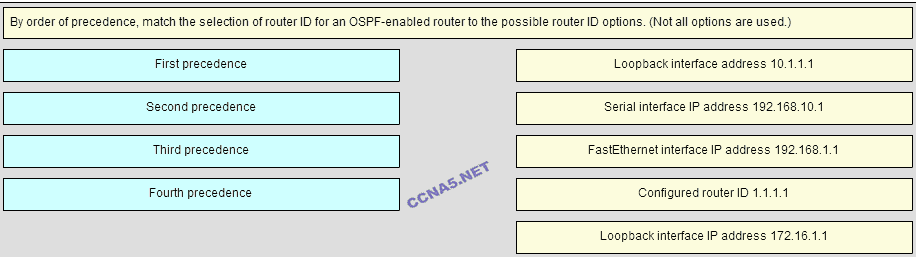
Place the options in the following order:
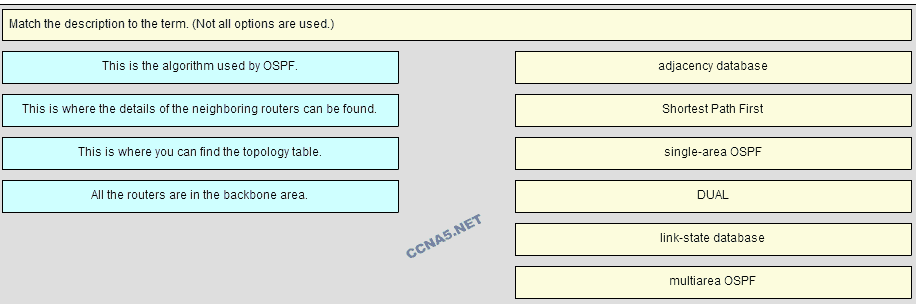
Place the options in the following order:
Which three statements describe the similarities between OSPFv2 and OSPFv3? (Choose three.)
What is a function of OSPF hello packets?
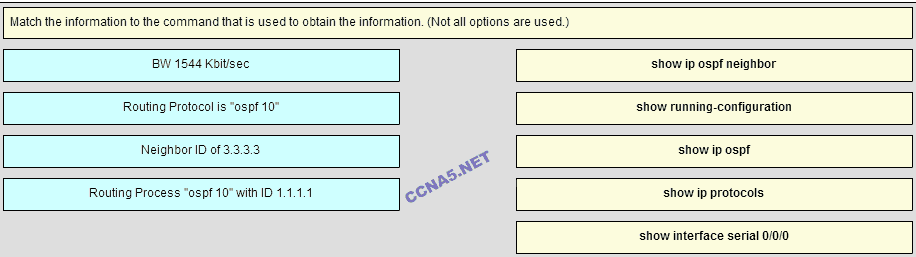
Place the options in the following order:
What are the two purposes of an OSPF router ID? (Choose two.)
Which command will verify that a router that is running OSPFv3 has formed an adjacency with other routers in its OSPF area?
Single area OSPFv3 has been enabled on a router via the ipv6 router ospf 20 command. Which command will enable this OSPFv3 process on an interface of that router?
When a network engineer is configuring OSPFv3 on a router, which command would the engineer issue immediately before configuring the router ID?
Which criterion is preferred by the router to choose a router ID?
Which OPSF packet contains the different types of link-state advertisements?
What does a Cisco router use automatically to create link-local addresses on serial interfaces when OSPFv3 is implemented?


Match the OSPF State with the order in which it occurs.
Answer Order:
- second state
- active state
- seventh sate
- fifth state
- first state
- fourth state
- passive state
- third state
- sixth state
Below are the test answers for Chapter 8, CCNAv2's OSPF Exam.
~
Which OSPF component is identical in all routers in an OSPF area after convergence?
routing table
link-state database*
SPF tree
adjacency database
link-state database*
SPF tree
adjacency database
Which three statements describe features of the OSPF topology table? (Choose three.)
When converged, all routers in an area have identical topology tables.*
Its contents are the result of running the SPF algorithm.
After convergence, the table only contains the lowest cost route entries for all known networks.
It is a link-state database that represents the network topology.*
The topology table contains feasible successor routes.
The table can be viewed via the show ip ospf database command.*
Its contents are the result of running the SPF algorithm.
After convergence, the table only contains the lowest cost route entries for all known networks.
It is a link-state database that represents the network topology.*
The topology table contains feasible successor routes.
The table can be viewed via the show ip ospf database command.*
3
A router is participating in an OPSFv2 domain. What will always happen if the dead interval expires before the router receives a hello packet from an adjacent DROTHER OPSF router?
A router is participating in an OPSFv2 domain. What will always happen if the dead interval expires before the router receives a hello packet from an adjacent DROTHER OPSF router?
SPF will run and determine which neighbor router is “down”.
OSPF will run a new DR/BDR election.
OSPF will remove that neighbor from the router link-state database.*
A new dead interval timer of 4 times the hello interval will start.
OSPF will run a new DR/BDR election.
OSPF will remove that neighbor from the router link-state database.*
A new dead interval timer of 4 times the hello interval will start.
4
Which command will provide information specific to OSPFv3 routes in the routing table?
Which command will provide information specific to OSPFv3 routes in the routing table?
show ip route ospf
show ip route
show ipv6 route ospf*
show ipv6 route
show ip route
show ipv6 route ospf*
show ipv6 route
5
Which wildcard mask would be used to advertise the 192.168.5.96/27 network as part of an OSPF configuration?
Which wildcard mask would be used to advertise the 192.168.5.96/27 network as part of an OSPF configuration?
0.0.0.32
0.0.0.31*
255.255.255.223
255.255.255.224
0.0.0.31*
255.255.255.223
255.255.255.224
6
A network administrator enters the command ipv6 router ospf 64 in global configuration mode. What is the result of this command?
A network administrator enters the command ipv6 router ospf 64 in global configuration mode. What is the result of this command?
The OSPFv3 process will be assigned an ID of 64.*
The router will be assigned a router ID of 64.
The router will be assigned an autonomous system number of 64.
The reference bandwidth will be set to 64 Mb/s.
The router will be assigned a router ID of 64.
The router will be assigned an autonomous system number of 64.
The reference bandwidth will be set to 64 Mb/s.
Fill in the blank.
The election of a DR and a BDR takes place on ” multiaccess ” networks, such as Ethernet networks.
Fill in the blank.
OSPF uses ” cost ” as a metric.
OSPF uses ” cost ” as a metric.
Which command should be used to check the OSPF process ID, the router ID, networks the router is advertising, the neighbors the router is receiving updates from, and the default administrative distance?
show ip protocols*
show ip ospf interface
show ip ospf
show ip ospf neighbor
show ip ospf interface
show ip ospf
show ip ospf neighbor
10
Which OSPFv3 function works differently from OSPFv2?
Which OSPFv3 function works differently from OSPFv2?
authentication*
metric calculation
hello mechanism
election process
OSPF packet types
metric calculation
hello mechanism
election process
OSPF packet types
Launch PT – Hide and Save PT
Open the PT Activity. Perform the tasks in the activity instructions and then complete the task.
Open the PT Activity. Perform the tasks in the activity instructions and then complete the task.
What message is displayed on www.ciscoville.com?
The correct configuration on R1 is:
router ospf 10
network 192.168.2.0 0.0.0.255 area 0
network 10.0.10.0 0.0.0.3 area 0
router ospf 10
network 192.168.2.0 0.0.0.255 area 0
network 10.0.10.0 0.0.0.3 area 0
The correct configuration on R2 is:
router ospf 10
network 10.0.10.0 0.0.0.3 area 0
network 10.0.10.4 0.0.0.3 area 0
network 172.16.5.0 0.0.0.255 area 0
Completion!*
Converged!
Success!
Finished
router ospf 10
network 10.0.10.0 0.0.0.3 area 0
network 10.0.10.4 0.0.0.3 area 0
network 172.16.5.0 0.0.0.255 area 0
Completion!*
Converged!
Success!
Finished
Fill in the blank. Do not use abbreviations.
To quickly verify OSPFv3 configuration information including the OSPF process ID, the router ID, and the interfaces enabled for OSPFv3, you need to issue the command ” show ipv6 protocols ”
By order of precedence, match the selection of router ID for an OSPF-enabled router to the possible router ID options. (Not all are used).
Place the options in the following order:
Third precedence
Fourth precedence
– not scored –
First precedence
Second precedence
Fourth precedence
– not scored –
First precedence
Second precedence
Place the options in the following order:
This is where the details of the neighboring routers can be found.
This is the algorithm used by OSPF.
All the routers are in the backbone area.
– not scored –
This is where you can find the topology table.
– not scored –
This is the algorithm used by OSPF.
All the routers are in the backbone area.
– not scored –
This is where you can find the topology table.
– not scored –
Which three statements describe the similarities between OSPFv2 and OSPFv3? (Choose three.)
They both have unicast routing enabled by default.
They both use the exit interface address as the source address when sending OSPF messages.
They both use the same DR/BDR election process.*
They both support IPsec for authentication.
They both share the concept of multiple areas.*
They both are link-state protocols.*
They both use the exit interface address as the source address when sending OSPF messages.
They both use the same DR/BDR election process.*
They both support IPsec for authentication.
They both share the concept of multiple areas.*
They both are link-state protocols.*
What is a function of OSPF hello packets?
to send specifically requested link-state records
to discover neighbors and build adjacencies between them*
to request specific link-state records from neighbor routers
to ensure database synchronization between routers
to discover neighbors and build adjacencies between them*
to request specific link-state records from neighbor routers
to ensure database synchronization between routers
Place the options in the following order:
Neighbor ID of 3.3.3.3
– not scored –
Routing Process “ospf 10” with ID 1.1.1.1
Routing Protocol is “ospf 10”
BW 1544 Kbit/sec
– not scored –
Routing Process “ospf 10” with ID 1.1.1.1
Routing Protocol is “ospf 10”
BW 1544 Kbit/sec
What are the two purposes of an OSPF router ID? (Choose two.)
to uniquely identify the router within the OSPF domain*
to enable the SPF algorithm to determine the lowest cost path to remote networks
to facilitate the transition of the OSPF neighbor state to Full
to facilitate router participation in the election of the designated router*
to facilitate the establishment of network convergence
to enable the SPF algorithm to determine the lowest cost path to remote networks
to facilitate the transition of the OSPF neighbor state to Full
to facilitate router participation in the election of the designated router*
to facilitate the establishment of network convergence
Which command will verify that a router that is running OSPFv3 has formed an adjacency with other routers in its OSPF area?
show ipv6 ospf neighbor*
show ipv6 route ospf
show ipv6 interface brief
show running-configuration
show ipv6 route ospf
show ipv6 interface brief
show running-configuration
Single area OSPFv3 has been enabled on a router via the ipv6 router ospf 20 command. Which command will enable this OSPFv3 process on an interface of that router?
ipv6 ospf 20 area 0*
ipv6 ospf 20 area 20
ipv6 ospf 0 area 20
ipv6 ospf 0 area 0
ipv6 ospf 20 area 20
ipv6 ospf 0 area 20
ipv6 ospf 0 area 0
When a network engineer is configuring OSPFv3 on a router, which command would the engineer issue immediately before configuring the router ID?
ipv6 router ospf 10*
ipv6 ospf 10 area 0
interface serial 0/0/1
clear ipv6 ospf process
ipv6 ospf 10 area 0
interface serial 0/0/1
clear ipv6 ospf process
Which criterion is preferred by the router to choose a router ID?
the IP address of the highest configured loopback interface on the router
the router-id rid command*
the IP address of the highest active OSPF-enabled interface
the IP address of the highest active interface on the router
the router-id rid command*
the IP address of the highest active OSPF-enabled interface
the IP address of the highest active interface on the router
Which OPSF packet contains the different types of link-state advertisements?
LSR
LSU*
DBD
LSAck
hello
LSU*
DBD
LSAck
hello
What does a Cisco router use automatically to create link-local addresses on serial interfaces when OSPFv3 is implemented?
an Ethernet interface MAC address available on the router, the FE80::/10 prefix, and the EUI-64 process*
the MAC address of the serial interface, the FE80::/10 prefix, and the EUI-64 process
the FE80::/10 prefix and the EUI-48 process
the highest MAC address available on the router, the FE80::/10 prefix, and the EUI-48 process
the MAC address of the serial interface, the FE80::/10 prefix, and the EUI-64 process
the FE80::/10 prefix and the EUI-48 process
the highest MAC address available on the router, the FE80::/10 prefix, and the EUI-48 process
A router is participating in an OSPFv2 domain. What will always happen if the dead interval expires before the router receives a hello packet from an adjacent DROTHER OSPF router?
OSPF will run a new DR/BDR election.
SPF will run and determine which neighbor router is “down”.
A new dead interval timer of 4 times the hello interval will start.
OSPF will remove that neighbor from the router link-state database.*
SPF will run and determine which neighbor router is “down”.
A new dead interval timer of 4 times the hello interval will start.
OSPF will remove that neighbor from the router link-state database.*
What is the first criterion used by OSPF routers to elect a DR?
Highest priority*
Highest IP address
Highest MAC address
Highest router ID
Highest IP address
Highest MAC address
Highest router ID
Which OSPFv3 function works differently from OSPFv2?
OSPF packet types
election process
hello mechanism
metric authentication
authentication*
election process
hello mechanism
metric authentication
authentication*
What is used to create the OSPF neighbor table?
adjacency database *
routing rable
link-state database
forwarding database
adjacency database *
routing rable
link-state database
forwarding database
What are two reasons that will prevent routers from forming an OSPFv2 adjacency? (Choose two.)
mismatched subnet masks on the link interfaces *
use of private IP addresses on the link interfaces
one router connecting to a FastEthernet port on the switch and the other connecting to a GigabitEthernet port
a mismatched Cisco IOS version that is used
mismatched OSPF Hello or Dead timers *
mismatched subnet masks on the link interfaces *
use of private IP addresses on the link interfaces
one router connecting to a FastEthernet port on the switch and the other connecting to a GigabitEthernet port
a mismatched Cisco IOS version that is used
mismatched OSPF Hello or Dead timers *
What command would be issued to determine if a routing protocol-initiated relationship has been made with an adjacent router?
show ip protocols
ping
show ip interface brief
show ip ospf neighbor *
show ip protocols
ping
show ip interface brief
show ip ospf neighbor *
Which three addresses could be used as the destination address for OSPFv3 messages? (Choose three.)
FF02::5 *
FF02::1:2
FE80::1 *
FF02::6 *
FF02::A
2001:db8:cafe::1
FF02::5 *
FF02::1:2
FE80::1 *
FF02::6 *
FF02::A
2001:db8:cafe::1
Match the OSPF state with the order in which they occur (not all options are used).
A: order
second state
– not scored –
seventh state
fifth state
first state
fourth state
– not scored –
third state
sixth state
A: order
second state
– not scored –
seventh state
fifth state
first state
fourth state
– not scored –
third state
sixth state
Refer to the exhibit. A network administrator issued the command show ip ospf interface on the router R2. What conclusion can be drawn?
R2 has not formed an adjacency with any other router *
R2 is connecting to a point-to-point network
R2 is configured with the OSPF router-id command
R2 is not configured with default Hello and Dead timer values
R2 has not formed an adjacency with any other router *
R2 is connecting to a point-to-point network
R2 is configured with the OSPF router-id command
R2 is not configured with default Hello and Dead timer values
What command would be used to determine if a routing protocol-initiated relationship had been made with an adjacent router?
show ip protocols
ping
show ip ospf neighbor*
show ip interface brief
Drag and drop
Match the OSPF State with the order in which it occurs.
Answer Order:
- second state
- active state
- seventh sate
- fifth state
- first state
- fourth state
- passive state
- third state
- sixth state


)
0 comments:
Post a Comment